We ALL have connection to country. That was something an Indigenous man said to me recently.
This is not trying to deny or compare the deep rooted connection to county the Wotjobaluk people might feel or experience (you can read more at https://www.dyurrite.com.au/), but rather to highlight that Arapiles has real and meaningful connection to all peoples who have invested a good chunk of their lives there. Living, camping, locals, and climbers.
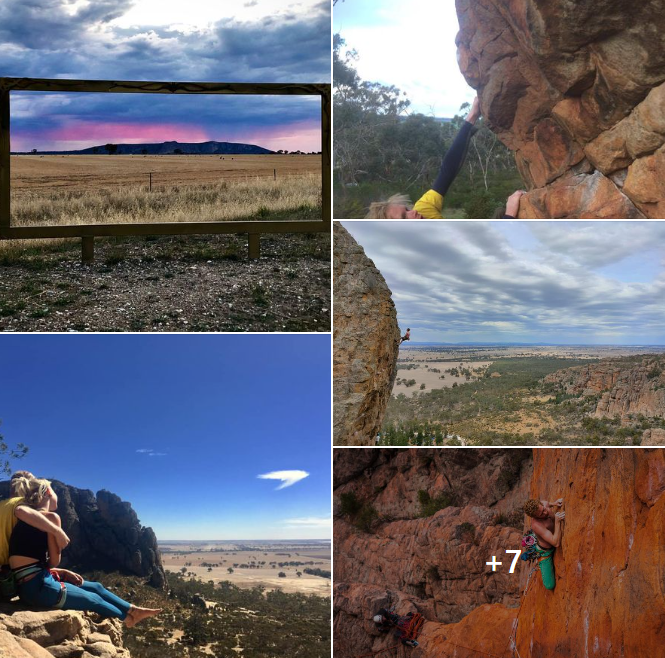
For more and newer stories – Check out the Humans Of Arapiles Page on Facebook:
Or: https://www.instagram.com/humansofarapiles/
Carey Scheer has created some fantastic mini docos of climbers and why Arapiles / Djuritte is so important to them. Well worth watching.
Ryan Gaskon
What is a home? Is it simply a place in which to live? To occupy, to function, to survive?
Or is it more? Is it a place of freedom, of safety, of belonging and welcoming. A place to be your true and authentic self.
Dyurrite/Mt Arapiles is that place for me. In the almost 11 years I’ve been visiting and climbing here, having first visited from Central Australia as a wide eyed 16 year old it has evolved for me from a place of wonder and education, to an escape and a distraction, to a magical home of connection and belonging.
My heart breaks for these announced bans, and when I first heard about them and read through the draft management plan, I could do nothing but sink to the ground, curl up and cry. This post is not about that though. This is simply wishing to share my love for this place and what it means to me.
Arapiles and its community saved my life.
Climbing is my world, I live it and breathe it, I need it to function. And just as climbing has been the centre of my life, so too has Arapiles been the centre of my climbing.
I climbed my first 25, 27, 28 and recently 29 here. I bouldered my first V2, 6, 8, 9 and 10 here. All my hardest trad ascents have been here. But these are all just numbers, insignificant in comparison to the special memories and friendships made and shared here that will remain dearly cherished with me for the rest of my life.
This is a special place, unique and magical in equals. So many kind and beautiful people I’ve met out here, all brought together and connected by our love for climbing and the natural world.
For almost as long as I have been climbing Mount Arapiles has been there with me, guiding me at times, educating me at others, and sheltering me when needed.
I love this place. I love its smooth stone, it’s imperfectly perfect cracks, it’s spritely skinks and beautiful flowers. I love its sunshine and its rain. I love its people, men and women, old and young, from near and far.
I love turning up at the Pines, usually at midnight on a Friday. Aiming for my now customary spot next to the watertank on the upper left side. I know the flat spots there. I know the shade. I love swimming in the river, having learnt to backflip off the rope swing. I love dumpster diving in Horsham and using the money I saved to buy an item or two from the mountain shop in Nati.
I was here in 2014 learning to place gear and build trad anchors for the first time. When I arrived after dark and blown away the next day by the grandeur and scale of the place comparted to what I’d been climbing in Central Australia. I was here in 2016 when I desperately needed an escape after failing to make the Australian Youth Climbing team. I was here for the highlining festival and John’s tent in 2017, I played on Jai’s pool table – propped up on bricks and perfectly flat thanks to a spirit level in 2019. I was here for all the locations and custodians of the gypsy tent. I was here for so many group cook ups, pizza parties and shared 4$ wine casks. I was here just after the first bans were announced. I was here for the recent rescue on Mr Chicken.
These moments, memories and people have shaped me, made me who I am and for that I am incredibly thankful, for I know that I wouldn’t be a fraction of the climber or person I am today without this place.
There is magic out here. I know it. And I’m sure that all those I’ve shared it with know it too.
Arapiles means the world to me, for so many reasons beyond just climbing. It will always have this tremendous meaning to me and to it I hope I can always return.
That sure sounds like a home to me…
Simon Carter (Onsight.com.au)
I’ve been asked to comment on the Victorian government’s announcement to effectively wipe out rock-climbing at Mt Arapiles. I’m currently in Canada, on my way home from Banff, where “The Art of Climbing” won Best Book Mountain Image. If I hoped my work would lead to a better understanding of climbing, clearly I have a lot more work to do.
I am heartbroken. Heartbroken for my community – and my nation.
There is no justification for bans of this magnitude, absolutely none. I am angry that it has come to this. We always knew that it could.
Firstly, the government’s claim that consultation occurred is gaslighting of the climbing community. As a member of the ACAV committee, I can assure you that there was none. We were cleverly sidelined over recent years and all submissions were ignored. Generally speaking (not just talking about the ACAV – but the community as a whole), the viewpoints and suggestions of climbers’ have been completely ignored.
Secondly, there needs to be a governmental enquiry into all this. Climbers have an incredibly long list of things that are wrong with the process itself. I want the conduct of numerous individuals examined. And the current cultural heritage laws, which have allowed this to happen, are unworkable and need changing. This is a political issue now. I could go on and on…
But, it is the suggestion that one culture needs to be destroyed to preserve another, that offends me the most.
Given the connection that climbers have with this place and its significance, I just don’t see how climbers can sit back and allow this to be taken away from future generations. No one has a problem with reasonable restrictions. As a guidebook publisher, I’ve always been all-ears in ways I can help.
So, I am very sad today. Sad for climbing, that most wonderful thing that we love. Sad for my community and the unjustifiable (further) devastation this will inevitably reap. And sad for this troubled nation – this is the last thing we need.
Shame on those who pushed for it to come to this or facilitated it in any way. Good intentions don’t cut it when so much is at stake, nor excuse dishonesty, it requires due process and balanced decisions. I think this will go down in history as a monumentally stupid home goal.
Ollie Sherlock
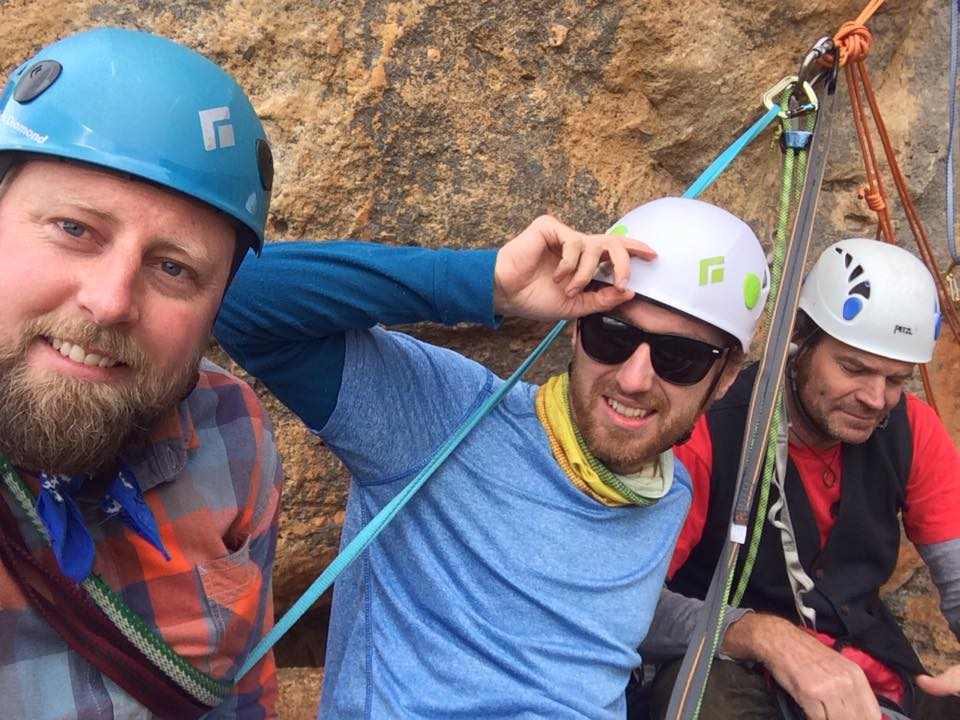
I’ve reflected a lot over the past few days, hearing stories of climbers connection to this place – Arapiles/Djurrite during these rather bleak times for our climbing community and I feel it’s time to share my personal story also.
I live in Melbourne’s South-East Suburbs and volunteered with the local State Emergency Service Unit as a Rescue worker in one of the busiest Road Accident Rescue Units in the State for many years.
Over the time of involvement, I attended literally hundreds of horrific accidents, murders, suicides and over 50 fatal incidents.
After becoming extremely unwell, I was diagnosed with PTSD in 2005 and after 15 of volunteer service decided to hang up the orange overalls and focus on recovery and learning to live with the illness.
I knew I would need to replace that significant part of my life with something else as I healed from the trauma and rock climbing was what I threw myself into.
Rock Climbing had always been an interest and I joined the Victorian Climbing Club (VCC), turning up to the Pines campground on a weekend Arapiles trip where I was welcomed with open arms by the group and taken under the wing of the trip leader for the weekend.
I climbed Zena and a bunch of routes in the Organ Pipes that weekend, was immediately hooked and knew this was just what I needed in my life at the time as I worked through the issues that I needed to face.
I’ve been returning to Arapiles for 12 years now and have met many lifelong friends and had some amazing experiences and moments along the way and also feel a very close connection to the Mount, my happy place!
Whilst involved with the VCC, I took on a project of replacing many of the ageing and senescing exotic Pine Trees in the campgrounds using my skills as a Horticulturalist and Conservation Officer, with indigenous trees I grew from seeds collected at the Mount – 350 in total were propagated, grown and planted out at CliffCare Planting Working Bees on Queens Birthday Weekend each year in The Pines, Upper Gums and other areas of the Park.
This project gave me a sense of purpose and satisfaction at a time when things were pretty tough and returning to the Pines in recent years it has brought immense joy to see them flourishing – thankyou to all who have looked after them along the way and supplied vital water over the hot Summers!
Rock Climbing has also helped me in managing the depression and anxiety that goes with the territory of living with PTSD, working through the mind games when you are feeling stressed and anxious – one move at a time and I feel is a great therapy for people recovering from trauma.
It saddens me to think that others will not have the opportunities that I have had, and I do worry about the risk of further closures that may come and the loss particularly of many of the lower grade entry level routes.
As a father of two teenage boys, I see the harm caused by excessive ‘screen time’ and feel rock climbing offers a great escape from this for our youth and an opportunity to connect with nature.
I would be happy to share my story and connection to Arapiles in any work that is being done in the access space.
Please be kind to one another during these difficult times and look out for fellow climbers and community affected by these recent announcements.
Ollie
Emma O’Brien
25 years ago I came to Natimuk with a fellow backpacker, to travel and climb in Australia. We had started our journey in Sydney, climbing the slabs at Narrabeen, the cliff at the Home & Away beach, volunteered with Cliffcare in the Blue Mountains before making our way to the Grampians and Mt Arapiles via Adelaide. Upon our arrival in Natimuk, we found a community that welcomed us, gave me a home for 3 months, advised us on gear and climbs and made lifelong friends. It is that community that introduced me to my future husband, gave me a place to stay for my first Aussie Christmas (the infamous Quamby Lodge backpackers) and I saw the new year 2000 in at Mount Arapiles (no sign of Y2K). Being a deaf female at the age of 22 way back then, I felt completely safe and at ease in the climbing community that Natimuk has to offer. Since then, my husband and I introduced our daughter to the wonder of rock climbing, we would take her to gymnastics competitions at the fantastic Natimuk club facility and attend the Frinj festivals. Wedding at the lake and many memories of dinners at the pub. I will always have a connection to the mountain, to the community even though we haven’t climbed for a few years. Being deaf I often prefer routes with a reasonable line of sight so I can see where to go and communicate with the climber / belayer. From a safety point this is important. To have fantastic routes such as Tiptoe, Bushrangers, Dec Crag, etc blocked from access is truly heartbreaking to those who need to remain connected to the mountain and the community as a whole. Surely there has to be a way to reconcile and reconnect without blanket bans.
Suzy Goldner
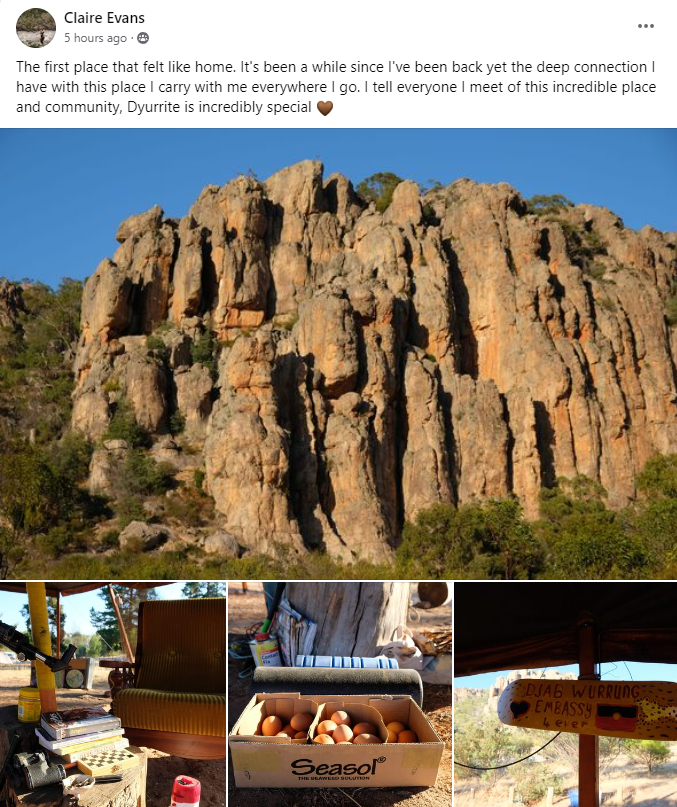
This is just heartbreaking. Mt Arapiles isn’t just a climbing spot—it’s home for so many of us. It’s where we’ve spent countless hours connecting with nature, challenging ourselves, and building a community that’s tied to this land. To see the Victorian government impose sweeping closures without even talking to the people who love and care for this place is a real slap in the face.
Climbers have been some of the most dedicated stewards of Mt Arapiles. For decades, we’ve maintained trails, educated newcomers, and respected the land’s history. Closing up to half the routes feels like an extreme, blunt-force approach that shows no consideration for the community or the local businesses in Natimuk that depend on sustainable climbing tourism.
I get that protecting cultural heritage is crucial, and we’d be more than willing to work together on a balanced plan that protects specific areas. But this decision was reached through secretive studies and announced at a time designed to dodge public scrutiny. It’s as if the community that calls this place home doesn’t even matter.
We need a solution that allows for both cultural preservation and responsible access to this place we love. There’s room for compromise here. But this? This feels like the heart of Australian climbing culture has been ripped out, and honestly, it’s just devastating.
Zorba Parer
My name is Zorba Parer, and I am speaking out with outrage and hurt over the proposed bans on climbing at Mount Arapiles.
When I arrived at the Mount in 2021, I was a broken man, 105 kilos, and recently relieved of the compulsion to drink alchaholically. My life was in shambles, and it was there in the Pines that I was held by the climbing tribe, until I was healed. I have broken myself upon Lady Djurrite’s hard rock, and she has welcomed me back every time. Now I sit a much bettered version of myself, 67 kilos, fit and capable, with family willing to talk to me, and a life filled with friends, new and old.
The furore around banning climbs at Arapiles, isn’t just about losing access to rocks; it’s about losing a spiritual sanctuary where many of us have found profound healing and connection. For me, climbing is not merely a physical activity—it’s a spiritual discipline that allows me to enter a state of flow and connect with God in ways nothing else can.
Climbing is my church. It’s where I find the silence and focus needed to connect deeply with my spirit and with God. When I’m on the rock, time slows down, my mind quiets, and I am fully present in the moment. This state of flow is not just about physical movement; it’s a spiritual experience that fills me with life and joy. The challenges of climbing force me to let go of distractions and be completely in tune with my body, mind, and spirit. It’s in these moments that I feel closest to God, experiencing a natural transcendence that purifies my intentions and sharpens my focus on what truly matters.
The proposed bans threaten not only our spiritual sanctuary but also some of the best climbing routes in the world. Mount Arapiles is home to iconic climbs like Muldoon (13), Lamplighter (14), Oceanoid (17), and Punks in the Gym (32). These routes are renowned globally for their quality and challenge, offering experiences that are unparalleled anywhere else. Losing access to these climbs would be a devastating blow to the climbing community, depriving future climbers of the chance to test themselves on these world-class routes.
The Victorian government’s plan to close nearly half of the climbing areas at Mount Arapiles feels like an attack on our ability to connect with something greater than ourselves—a connection that many of us desperately need for our well-being. It’s not just an economic blow; it’s an emotional one that could strip future climbers of the chance to find their own spiritual refuge.
This decision is emblematic of broader structural issues within Victoria’s state governance, where authoritarianism and top-down power structures are systemic. The lack of consultation with the climbing community reflects a pattern of governance that prioritizes decisions made behind closed doors over transparent dialogue with those affected. This approach not only alienates communities but also undermines trust in public administration. It also signals to all the other climbing tribes around Australia, that their cliffs are not safe from the imperialist nanny states being driven by fear of upsetting our first nation sovereigns.
I understand the importance of preserving cultural heritage sites, I disagree that the prejudgements of climbing impacts on these sites has any base in the evidence. The lack of evidence of harm, and impotent consultation with climbers is infuriating. We are not vandals; we are stewards of the land who deeply respect its history and significance. There must be a way to balance cultural preservation with recreational access.
I speak out because I believe in the power of climbing to transform lives, as it has transformed mine. I urge the authorities to engage with us, listen to our stories, and consider the impact these bans will have on future generations seeking refuge in climbing’s embrace. Let’s find a solution that honors both our cultural heritage and our need for healing spaces through this spiritual practice.
Until then, to the Governments of Australia, with all due civility, I am disinclined to rescind my natural right to climb.
Zorba Parer
Bachelor Science Aerospace Engineering,
Master Of International Law
Blackpoint Dirtbag
Citizen of Australia
Locky Dougherty
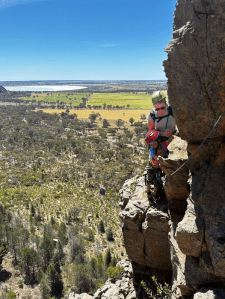
Here is a photo of my Son Luca doing the Tip Toe Ridge step across at 4 years old.
I absolutely see the need to protect and honor Indigenous culture, and I wholeheartedly support it. Yet I wonder at what point we also make space to protect and celebrate the culture of our current generation.
For me, Mount Arapiles holds a deep spiritual significance. It’s where I first discovered a true connection to the land—a bond that, without the freedom to climb and explore, might never have formed. I’ve been sharing this experience with my son, Luca, who started climbing here at just under four years old. Introducing him to Arapiles and the world of climbing has felt like passing down something culturally and spiritually essential. It’s one of his favorite places to camp, with Tip Toe Ridge holding a special place in his heart—a climb he won’t get to experience again now that it’s banned.
I want nothing more than to see ancient Indigenous culture honored, but it deeply pains me to see this come at the expense of today’s connection to these lands. This is something I’d hoped to share with my son and future generations, building a legacy of respect, adventure, and reverence for Mount Arapiles.
Brendan Goossens
I feel like my home has been taken away. I’ve climbed at Araps for 40 years. My kids grew up there. I reside elsewhere for work, but have always felt like Araps was ‘home’. It is where I choose to spend my time.
Close half the mount because of quarry sites, I don’t get it, what damage has been done to them? I fully agree that sites of cultural significance need protection, but quarry sites surely dont qualify as culturally significant. Art sites yes, ceremonial sites yes, but chipped rocks?
What is next, close all river and ocean beaches that have historic rubbish heaps (middens) to all walkers, paddlers, surfers, fisherpeople, or follow recent precidents and allow all other users there and just stop climbers going there too?
Research Papers on Climbers’ connection with country and relationships with nature.
Please take a look at this research paper by Bridget Hillebrand, Called “Climbing the Landscape: Mt Arapiles – Explorations in place and the printed image”:
My investigation into how climbers know and experience the landscape of Mt Arapiles through documented conversations and recorded field surveys has provided evidence that landscapes are constructed in social engagement. Places such as Mt Arapiles are imbued with memories, residues and the echoes of events and conversations that have occurred there and have become part of its cultural history.
Also, this paper on student outcomes from climbing at Mt Arapiles:
And – a research paper “Outdoor Adventure in promoting relationships with Nature”. By Peter Martin:
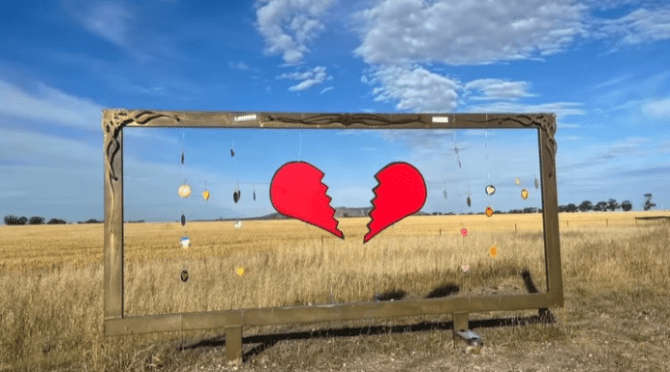
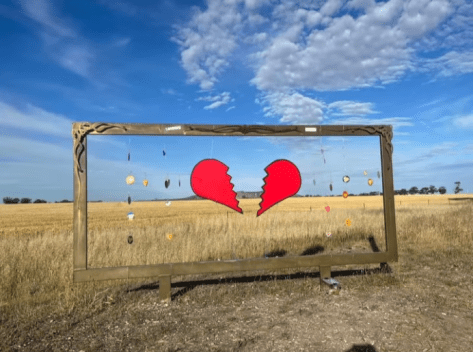
And this image… perfectly capsulating the feeling of the community right now.
 Save Grampians Climbing