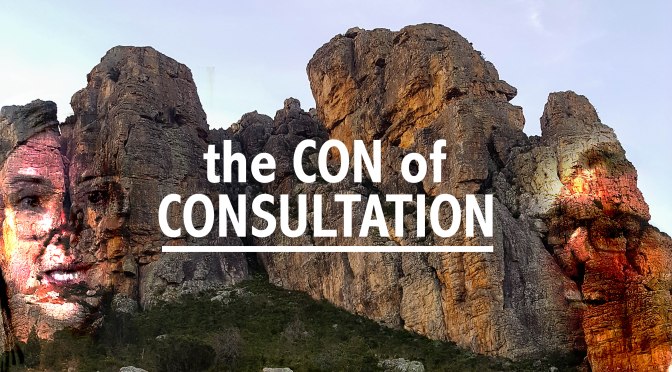
For over 4 years Parks Victoria and Barengi Gadjin Land Council (BGLC) have been working behind closed doors to formulate a plan to close more than half of the Mount Arapiles-Tooan State Park to all recreational users. This is a piece of public land who’s main users, up to this point, have been rock climbers – well over 50,000 a year and they make up more than 90% of the visitors to the park. These recently announced restrictions on access include some of the worlds largest climbing bans and eliminate thousands of individual climbing routes – many considered to be irreplaceable by the climbing community. Read the details of their plan here.
This article covers some of the ways that community consultation regarding these bans has been either ignored or manipulated to create a an end result that Parks Victoria and BGLC want.
Parks Victoria has announced community consultation about this plan on its Engage Victoria website – a familiar platform if you were around during the Grampians bans.
Have they “engaged” with the community in this journey? No.
Parks Victoria & BGLC have had 5 years to talk to the climbing community and local residents of Natimuk. 5 years to come up with a mutually agreeable process and outcome to protect “values” – cultural and natural. Instead PV gives us a pissy 28 days to write to them (apparently the minimum required under law), one webinar with restricted participants and absolutely zero participation from BGLC. Less than a month – and they don’t even want to discuss the climbing area closures. Check out this classic line from PV’s website
“It is important to note, this consultation will not be reviewing any changes to the areas that need to be protected.” – Engage Victoria website
If we are not talking about climbing area closures – why are we even here? They put it even more bluntly in the webinar with this smackdown to any dissenters…
“We want to make sure we are clear that the negotiables and the non-negotiables are clearly articulated to you.” – Dan McLaughlin, Executive Director Conservation and Planning
Those negotiables do not include rock climbing areas.
Side note – you will read and hear the word “values” a lot from Parks Victoria staff. It’s one of those buzzwords that only seems to have appeared in recent years. Loosely it means not just physical objects like rock art or a rare plant – but spiritual, ceremonial, connections etc. What they don’t mean is the “value” of the rock climbing history and use of the area.
Five years – 2019 to the present
These Arapiles climbing bans aren’t new. We have been reporting on them since 2019 – when the very first climbing ban appeared at Declaration Crag (Taylors Rock).
You can read our articles from 2019 and 2020 that give detailed information on how the government experimented with new legislation to slowly introduce restrictions bit by bit – without once ever “engaging” the climbing community on their plans – both immediate and long term. Climbers continue to act surprised when a new ban is announced at 5pm on a Friday. Are we really that stupid that we keep falling for it again and again?
June 2019 – Is Arapiles Next? We predicted the closures of major Arapiles crags that would mirror what was happening in nearby Grampians.
December 2019 – Dec Crag ban announced – we wrote about the first “temporary” and informal closure of a major feature at Arapiles. The optimism that this would all be rewound if we just behaved better is kind of sad in these earlier articles.
March 2020 Dec Crag Act Now! – we discuss the proposed very first use of an Interim Protection Declaration for Declaration Crag which prohibits all access to this area – even bushwalkers.
June 2020 – Declaration Protection It’s Official – we discuss the official announcement of the first Interim Protection Declaration at Arapiles and reveal some of the art.
October 2020 – Arapiles Protection Declaration Expires – we reveal the government fails to renew the protection declaration but instead begins formal surveys of other areas at Arapiles – and Mitre Rock and Castle crag are rumored to be banned soon. We also discuss the dodgy archeology tender process (or lack thereof).
October 2020 – 4500+ Climbs Closed – 38% Gramps and Arapiles Now off-Limits – huge “temporary” bans announced at Arapiles (no consultation, no warning – obviously!). Castle Crag, Tiger Wall, Bluffs, Fang Buttress and most of the bouldering is gone.
For 4 years Parks Victoria said nothing. We even wrote about the total lack of public discourse in 2022 in our article Days Gone By. It appeared they had either given up on further bans or run out of money for further assessments. How stupid we were.
November 2024 – Arapiles Climbing Bans The Plan – Even larger bans announced by Parks Victoria and BGLC on the night before Melbourne Cup. No consultation. Absolute outrage.
Half a decade of nothing
So you can see there is a more than a four year gap between the 2019 announcements and last week’s final plan to “terminate climbing”. So did either of the land managers – Parks Victoria or Barengi Gadjin Land Council – spend any time working with the climbing community during the half a decade gap between temporary bans at Declaration Crag – and now 63% bans of the entire park? No.
Let’s look at opportunities missed.
The architects of the bans – BGLC
BGLC are making most of the decisions about what areas are to be banned and what stays open as these bans mostly revolve around Aboriginal cultural heritage. These architects of the bans do not attend community “engagement” meetings – either in person or online, refuse to meet climbing representative groups and are rarely seen at Arapiles itself – a lost opportunity in community engagement. They have allegedly even refused to meet the Victorian Labor Minister for Environment last week. If you dare speak out against their organization or decision making process they will not attend meetings with you in them and label you racist. This is why climbing organizations are being sidelined and why Parks Victoria has made zero effort to get climbing organizations in the room with BGLC.
If you watched the Engage Victoria webnair you would have seen the poor presenters (senior managers at PV) constantly say “we are speaking on behalf of Parks Victoria and not traditional owners” – as there was no one from BGLC on the Zoom call to 500 interested participants from the community.
Unlike Parks Victoria, there is no legal requirement for BGLC to meet with the general public or invested users in the park they “joint manage” with Parks Victoria – even if a plan of [mis]management is heavily amended to remove access to most of the park (such as the new Dyurrite Cultural Landscape Management Plan Amendment). You can read BGLC’s press release about how they joint manage 12 areas of public land here.
This section seems relevant….
“The joint management plan embeds Traditional Owner knowledge, values and expertise in the management of the jointly managed land. The drafting process for the plan will include public consultation. The joint management plan must be consistent with Victorian Government state-wide policy to maintain public access.
Maintain access is not what is happening here. The entire western part of the park and Mitre Rock is now off-limits as it doesn’t have “approved” walking tracks – walking off track is prohibited.
Lack of community engagement from one half of the joint management “team” is one of the main reasons people are talking about needing change to the National Park and cultural heritage legislation. You can’t have one very important member acting above the public interest and any kind of oversight and maintain support from the general public.
Traditional Owner Land Management Board (to be established).
It gets messier though – BGLC joint managed land is supposed to be jointly managed by the State and BGLC through a Traditional Owner Land Management Board (to be established). According to the BGLC’s press release about their “Recognition and Settlement Agreement” that included Arapiles…
“A Traditional Owner Land Management Board will be established by the Minister for Environment after the settlement commences. A majority of members will be nominated by BGLC. The remaining members, representing the State and the broader community, will be nominated by the Department of Energy, Environment and Climate Action (DEECA).”
“In all cases, the parks and reserves will continue to be managed under the same Act of Parliament by which they are reserved, but will also be subject to a joint management plan developed by the Traditional Owner Land Management Board. Following public consultation, the Minister for Environment considers the Board’s plan. The Minister’s approval is required before the plan comes into effect.”
Does this board exist? And who are the members who represent the State and broader community? And where does this fit into the new plan to ban climbing?
Mt Arapiles/Tooan State Park Advisory Committee – kaput
In a not unconnected story we move onto another option that could have been used by PV to guide the process behind the proposed amended management plan for Arapiles – the Mt Arapiles/Tooan State Park Advisory Committee.
This group is supposed to consist of local community members and interested parties and is to officially “advise” Parks Victoria on any plans they may have for the park. It has existed for more than 40 years – since at least 1979 and in 2020 we reported that “Parks Victoria has appointed a new Mt Arapiles–Tooan State Park Advisory Group, to serve for the next three years. Eight were selected from 17 applications. New members are Jacqui Norris, Kate Dooley, Mark Gould and Paula Toal. Returning members are Keith Lockwood, Louise Shepherd, Mary French and John Uebergang. This is a very positive outcome – a group with many decades of experience. The group is scheduled to have its first meeting in April.”
According to the current draft plan and the previous plan, consultation with the Advisory committee is required. Page 2 has this cracker of a quote:
“Consultation will be carried out through the Park Advisory
Committee prior to amendment of the Plan in relation to issues which will have a significant impact on Park users.”
Shutting down more than half of the climbing seems like a pretty big change doesn’t it? Was this group consulted by Parks Victoria and BGLC? No – and for a big reason – the group was ignored and quietly disbanded by Parks Victoria sometime shortly after 2020.
One ex-member told us that PV’s Regional Director, Western Region called them a couple of times but then communication dropped off, PV appeared to have just lost interest in engaging. Another long term member of this committee, a prominent resident of Nati, left after being told their input about protecting climbing access was not appreciated by BGLC who refused to attend meetings when they were there (they hadn’t been to any leading up to this anyway).
It appears that “engaging” is only acceptable if you agree with the land managers. The demise of the Mt Arapiles/Tooan State Park Advisory Committee is a disgrace of public disengagement and further evidence of a “we know better than the community” mindset at PV.
Climbing Victoria & ACAV representing…
A couple of years ago (after the now infamous war of Victorian climbing organizations) we were told that Climbing Victoria was going to be the definitive contact point between Parks Victoria and the climbing community so there was never going to be a repeat of the Grampians bans. This group is a coalition of a the Victorian Climbing Club, Western Victoria Climbing Club, RMIT Outdoors Club, ClimbingQTs and Crag Stewards Victoria. Sport Climbing Victoria appears to no longer be involved in the outdoor space which makes sense. ACAV was missing from this group – more about that later. This was supposed to be the government and climbers working together on one page hand in hand into the future. Surely this was the great opportunity for PV “engagement” with the climbing community on a plan to ban routes on Australia’s greatest crag. Climbing Victoria even have the backing of Outdoors Victoria who is the government funded “peak body for outdoor education and active outdoor recreation in the state and advocates for and supports more Victorians to get active outdoors.“
Climbing Victoria was having reasonably regular meetings with Parks Victoria right up until the bans were announced – you can read their last report from one of these meetings in May 2024. Notice anything missing? Arapiles does not get a mention – because PV failed to mention anything to Climbing Victoria about the upcoming bans. At this stage the amended plan would have been finalized and PV and BGLC would have been spit and polishing up their flashy videos and media releases about it. We spoke to someone inside Climbing Victoria on the day that PV announced the bans and the fury was palpable. They were entirely side swiped. And since then? When someone asked PV staff at the Engage Victoria webinar how they would be contacting climbing organizations about the proposed bans their answer was – they should just use the Engage Victoria portal and submit something with all the other members of the public. Absolute bollocks and disrespect. Climbers tried to do the “right thing” by creating Climbing Victoria but – again – it was entirely ignored.
One gripe we have with Climbing Victoria right now is that one of their coalition members are refusing to even acknowledge the announced climbing bans. They are founding members of Climbing Victoria and run regular trips to Arapiles – what is the point of them being in this coalition if they can’t stand up publicly against loosing half of the world’s best trad climbing crag? At minimum they could be using their considerable social influence to “share” some of Climbing Victoria’s posts. We understand they are working behind the scenes which is great to hear.
ACAV? Parks Victoria has not spoken to them for years and they certainly weren’t given advance warning of the bans – or involved in drafting them . Interestingly we did get a hint from ACAV that something bad was coming a week before the bans were announced via an insider backgrounding. It would be highly unlikely that Parks Victoria would involve this colourful organization into their planning. The heat this group and other individuals are bringing to the Labor government and PV via political and mainstream media associations has been impressive. We suspect in a decade an oversight committee will be digging through emails between PV and the Labor government on these closures.
The Gariwerd Wimmera Reconciliation Network (GWRN)
GWRN has been the most “engaged” participant in BGLC’s work towards the amended plan banning climbing. You can read their first post about Arapiles in a December 2020 press release about their involvement in the Recreational Use Assessments Dyurrite (Mount Arapiles).
“BGLC has asked GWRN to be involved to provide advice and technical expertise on recreational use, in particular around considerations for rock climbing and bouldering.”
“Ideally, the climbing community, individuals or organisations, will support the recreational use assessment process and potentially be in a position to get more actively involved. GWRN will work with BGLC, the local and climbing community to support this to happen in a way that is safe and appropriate for everyone and enable respectful relationships to form.”
This particular press release was issued almost simultaneously with matching ones from BGLC and Parks Victoria. Other climbing organizations (sorry – “community reconciliation groups”) would dream of such a collaborative relationship. We didn’t see much evidence of this group working publicly with the climbing community (unless they meant themselves?).
Now this self-appointed community “reconciliation” group steadfastly holds onto the line that they aren’t a climbing organization and PV shouldn’t say they are. PV actually apologized during the 20204 Engage Victoria webinar for saying this in their original press-releases and has updated it to say that GWRN was used to represent the “recreational users perspective” – rather than just rock climbing. It’s not much better is it?
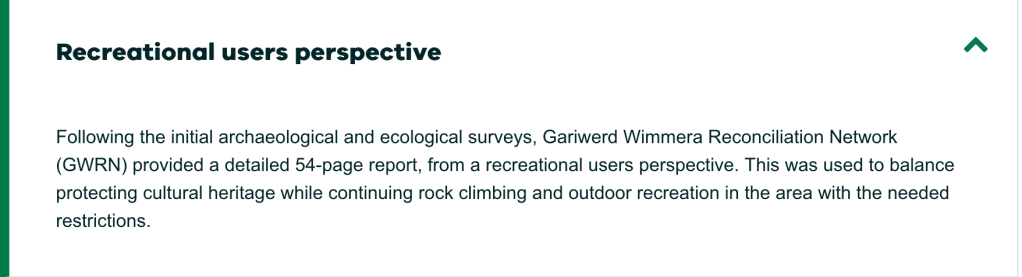
Problem is PV didn’t update the slides in the Engage Victoria webinar where GWRN are labeled “rock climbing specialists” – opps.
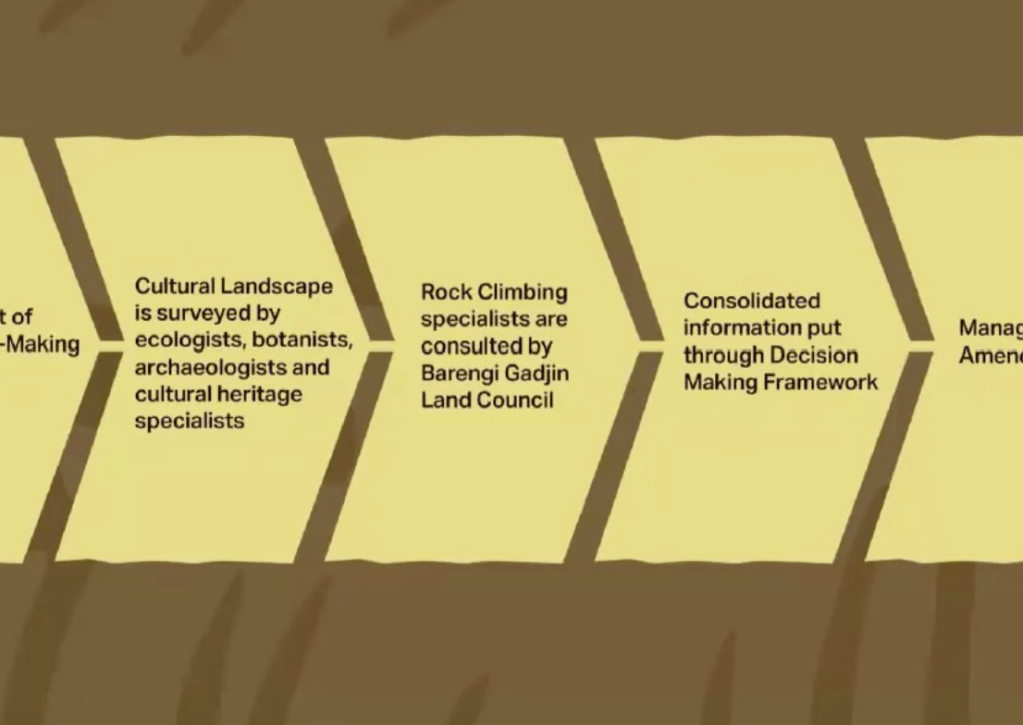
GWRN worked directly with BGLC from 2020 onwards to produce a 54-page report about how rock climbers use Arapiles at a route by route level (seemingly partly ignored by PV who then banned areas rather than individual routes). This report was used to formulate what needed to be banned forever or restricted temporarily until further works could be done to potentially reopen them. PV went to great lengths to say not all of the “temporary” bans will result in a future reopening (leaving areas such as Muldoon, Kachoong, Watchtower left faces etc in total limbo).
Now if there was an opportunity for GWRN’s “members of the Victorian climbing community” to inform, engage and influence the direction of the amended plan of management this was it. They were issuing joint press releases, getting happy snaps together and generally being collaborative on the ground and with the people in power.
But what happened? It seems all that “engaging” was just a convenient stepping stone for the land managers to say they had collaborated with the climbing community, tick that box, issue a press release saying so (this time without GWRN) and then saying there will be no more discussion on area closures. We feel sorry for GWRN. We know of at least one member who was left fuming from the way they were treated by PV in this announcement.

This group had known about what areas were on the likely chopping block for at least two years yet they allowed the climbing community, including Climbing Victoria, to waltz along without concerns. You can read about GWRN’s involvement in their recent press release below.
Interesting to note that GWRN is still not offering up membership – despite their 2020 press release saying “For those who want to actively be involved in supporting the vision and purposes of GWRN, we are planning to welcome new members early next year.” We know several members of the organization from 2020 have have left citing irreconcilable differences.
thecrag.com is PVs virtual climbing buddy
This is an odd one – but Parks Victoria staff mentioned on multiple occasions during the Engage Victoria webinar that thecrag.com was a great source of information for them. They could see maps, area names, user statistics and all sorts of great stuff about how climbing operates at Arapiles. And they could do all of this without having to “engage” any climbers at all. They used the maps on this website to formulate their closure plans – one click and Pharos is gone. Can we just delete this website now?
PV also mentioned that they used drones to survey much of the area as they lacked the ability to climb up cliffs for surveys.
Zoom Zoom – the Dyurrite Community Information Session webinar
Over 500 people signed up for the only “information session” that Parks Victoria is doing for the general public about the Arapiles climbing bans. This was an online event – strictly managed – with all questions being filtered through a meeting facilitator. There was no ability to ask a question directly – face to face or screen to screen. Even during the Grampians bans PV had the guts to run multiple community meetings and online forums. They clearly needed to curtail an insurrection from climbers in a crisp 1.5 hour webinar with not a climber in sight.
PV moved the webnair from a simple Microsoft Teams meeting to Zoom and hired the professional public facilitator at the last minute when they realized just how big it was going to be. Even at 500 participants PV had to limit the capacity as it was clearly overwhelming to manage. Lots of interested and enraged climbers didn’t get a chance to even tune in. There was clearly a whole bunch of “helpers” offscreen trying to manage a barrage of questions to the stressed presenters. At one point it became so overwhelming for the professional facilitator to manage in coming questions she asked one of the other speakers to take over.
It was clear that everyone was not lining up to thank Parks Victoria for such an excellent job with the new amended plan for Arapiles.
Purpose to communicate
For anyone who thought this “engagement” was an opportunity to find out details on why particular areas were closed – they were about to be disappointed. Talk to a traditional owner? Nope. See evidence of climber damage? Pass. Present the benefits of rock climbing at Arapiles to the land manager? Laughable.
The clear purpose of the “Dyurrite Community Information Session” was to “communicate” the plan that Parks Victoria and BGLC have cooked up. This was not a session for the community to inform Parks Victoria of their concerns. This was clear right off the bat…
“We want to make sure we are clear that the negotiables and the non-negotiables are clearly articulated to you”
The only feedback Parks Victoria actually sought in this session was how they could improve “access” to designated climbing areas (escalators?) and how they could attract other recreational users to the park (presumably to replace climbers). We hear duck shooting would be a good replacement hey Jacinta Allan?
Here is the video of the webinar – we will reference timecode numbers for your viewing pleasure. Be prepared to waste an hour and a half of your life to learn very little.
Feel free to play Bullshit Bingo as you watch this presentation – our fav key words being accessibility, values, navigate, moving forward, experience, sustainable tourism, opportunities. What is your fav?
With 4 (yes 4!) acknowledgement of countries in the first 20 minutes its clear which side of this debate Parks Victoria is taking. [hint – it’s not yours]
Our fine captains of industry from Parks Victoria presenting are…
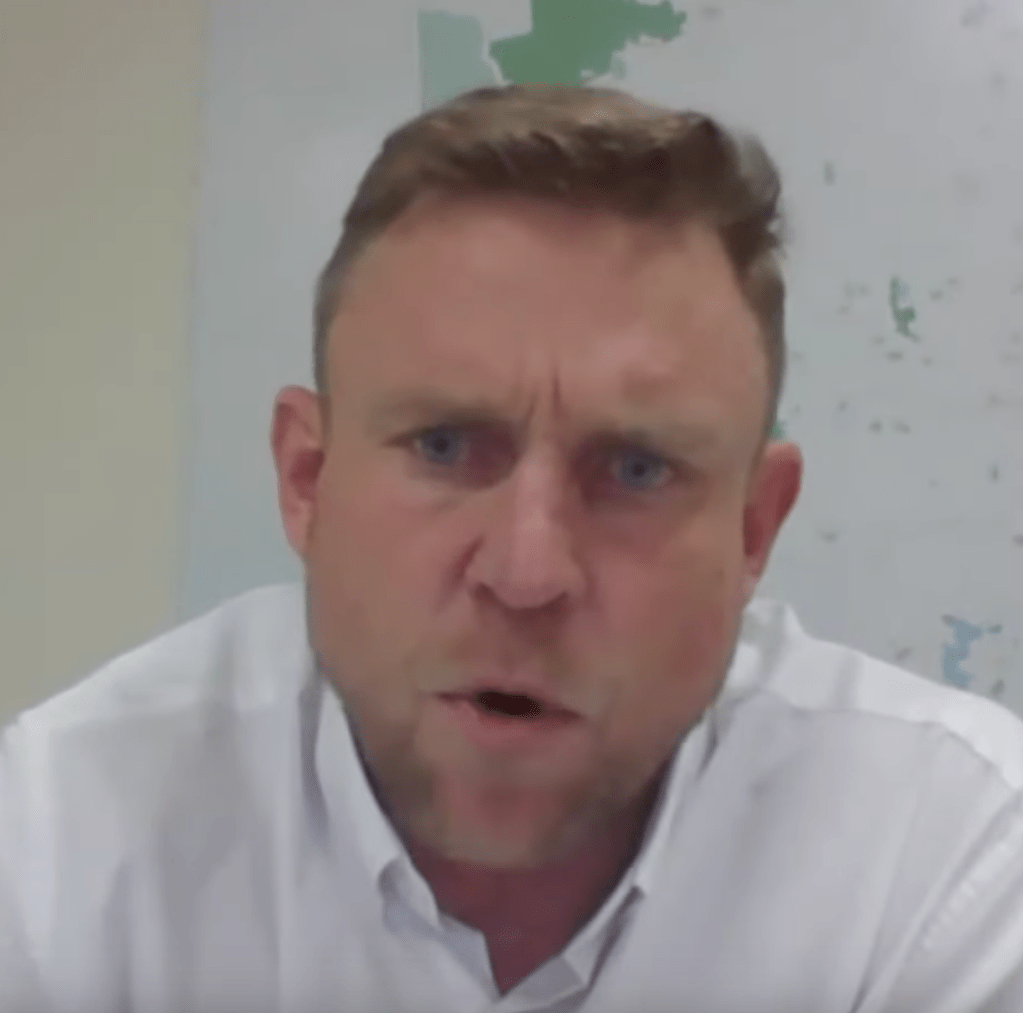
Patroni and Hughes are familiar names associated with the Grampians climbing bans from 2019 to 2022.
Transparent and open
At 3m55 we get Park Victoria’s community engagement “Values” [its that word again!]
“we believe in being transparent and open. We are committed to listening to you and addressing your concerns”
The big problem here – which will be addressed later on – is that so much of the process and results of the surveys that found cultural and environmental “values” [damn we are using that word now] are kept secret. This secrecy is part of legislation to protect these “values” from damage from the general public. This is contentious as how can people protect something they don’t know exists. We have to trust that it is all above board – and honestly with PV and their archeologists history of smearing rock climbers this is a hard pill to swallow. We truly believe PV is unable to reveal this information – but it’s a sticking point for consultation and means “transparent and open” is just not possible. Don’t say it if it is not true.
Another thing that bugs us here at SGC is that there was again no acknowledgment of what the majority of 500 people were there for. They wanted to talk about the callous discarding of the climbing community, our culture and the climbs that have created this culture. Even a cursory acknowledgment would be appreciated – Here’s a suggestion at no cost PV “sorry, we understand that the following presentation could be distressing to you and understand that there is no perfect solution to protecting cultural and natural heritage. We understand this may have a negative effect on your mental health so please seek help if this is to much“. You know the drill. Empathy for the effects their plan is having on so many people. Remember those 90% users of the park? The general public? No?
Reasons for the bans
The first 20 or so minutes revolved around the reasons for the bans. It’s worth watching and compelling if you were not familiar with just how large and complex Arapiles geography is and how long climbers have already been climbing there for without causing harm. We will include a couple of snippets
7m26 – “This (presentation) will help people know exactly where they can continue to access the park for recreation without impacting any of the values that exist. This will lead to changes in the access lens. The changes bring certainty to where people can enjoy the park, where values have existed for thousands of years and will continue to be protected.”
8m20 – “The surveys has rediscovered tens of thousands of artifacts, scar trees, rock art with evidence dating back 3000 years, and one of the largest indigenous stones quarry complexes found in Australia.” – at least they added the word “indigenous” to the line this time – the Engage Victoria website and various media organizations quoting it keep saying it is one of the largest stone quarry complexes found in Australia – the current mining giants might beg to differ if that was the case!
8m30 – Information about flora (plants) including the threatened species such as the Skeleton Fork Fern (commonly found throughout the world including on rocks next to the Sydney Opera House!)
9m25 – Legislative requirements regarding National Parks including the “preservation and protection of the natural environment, indigenous flora and fauna and the responsible management of land”
10m30 – Info about PV’s obligation to manage the Tangible and Intangible Cultural Values that are protected by the Aboriginal Heritage Act. This is what makes it an offense to harm cultural heritage.
10m50 – information on why these values are sensitive and protected using non disclosure caveats and is not available to the general public.
11m32 – “The draft amendment of the management plan is seeking to clarify where people can recreate in the park that is not harming the protected values or putting them or Parks Victoria in a position of breaching legislation.” – Now the latter is important. Much of this rush to get the bans in place is from Park Victoria’s legal fears that they will breach legislation. This was also the trigger for the Grampians bans. They are trying to save their behinds.
13m02 thecrag.com mentioned as a resource used by PV to create maps etc. Also mentioned at 26:20 as the de facto climbing consultation – where the climbing routes are etc.
13m28 – “the outcome is that more than half of the climbing areas will remain open” – no it isn’t.
15m19 – “Throughout these assessment GWRN was not involved in any of the decision making about access or any of the draft management plans – just advising on access. GWRN did not act on behalf of the climbing community or claim to act as consultants for the climbing community. Parks Victoria acknowledges that we should have described GWRNs advisory role more clearly in initial communications that went out.” – translation – sorry we threw you under the bus GWRN. It was great to know you but now we have finished with you.
When do all the bans apply? Right now apparently
19m20 When asked when these bans would take effect the answer was “If people are still interested in visiting the park – if they are wanting to undertake climbing activities look at the draft management plan amendment – look at the map that identifies the 80 areas that are available to climbing and particularly the 64 that don’t need management actions. Those are the areas that people can continue to access with confidence that they are not impacting on values we have identified during the assessment,”… “For access right now look at those areas we have identified as open.” – so if you are a climbing ban apologist and still climbing at Pharos, Mitre Rock, Yesterday Gully, Kachoong, Muldoon, Watchtower left side then you are bad. ok? 37% of climbing is available officially according to Dan from PV.
Evidence based decision making – no evidence supplied
23m15 Talks about how they used an evidence and values based decision making process to come up with the closures – however all evidence about values is kept secret. Nothing is shown in the presentation.
They hire experts for archeology, plants and animals – but no climbers as part of the process of closing climbing areas.
Areas being protected are registered by Parks Victoria so “it’s really clear that those values are protected“. However – this information is kept secret so it’s really not clear at all to the general public.
30m40 Presenters mention evidence of damage – cut vegetation, informal tracks and chalk. Broader disturbance of ecology. No photographic or location based evidence supplied in presentation. Presume Parks Victoria has never damaged any vegetation – hold on – Parks Victoria clears vegetation the size of 7 MCG stadiums in the Grampians National Park. Interestingly we never ever hear of vegetation offsets when it comes to climbing areas but its always PV’s answer when they start mass chopping themselves for the latest tourist enterprise.
32m06 When asked what options were considered instead of large climbing restrictions the simple answer was “all options were considered”. Any more info about that? No. Transparent, clear, evidence. That’s our Parks Victoria.
Parks Victoria wants YOUR help (to replace climbing)
The second half of their presentation was around how to commercialize the park and kick out climbers for other groups that are more palatable. They didn’t actually say that but the intention was clear. Melbourne Head office sees an under utilized resource and they need a return on their investment. Lisa Patroni ran through her key talking points (bullshit bingo alert time – this is a home run for sure)
“We will really look for ways that hopefully we can find greater economic growth from this incredible landscape – particularly through broadening and raising the awareness of the site to new markets.”
“What you would want to see from the park? There are some great opportunities to think about what nature based tourism and cultural tourism could look like in this landscape”
36m29 A pretty tone deaf moment in the presentation was their request for everyone to give them feedback on four points…
“what other user group opportunities are there for Dyurrite?”
Not a lot. Ride a bike to a cliff to go climbing. Walk to a cliff to go climbing. Bird watchers? Sounds like you are trying to replace climbers.
“how can we grow nature based tourism?”
Rock climbing is nature based tourism and it’s really popular. Next.
“How can we raise the profile of this incredible park?”
You don’t need to. It’s really popular amongst rock climbers already and its in the middle of bumf&*k Victoria so unlikely others will want to go there. I hear grey nomad climbers love free camping.
“How can we improve accessibility to designated climbing areas?”
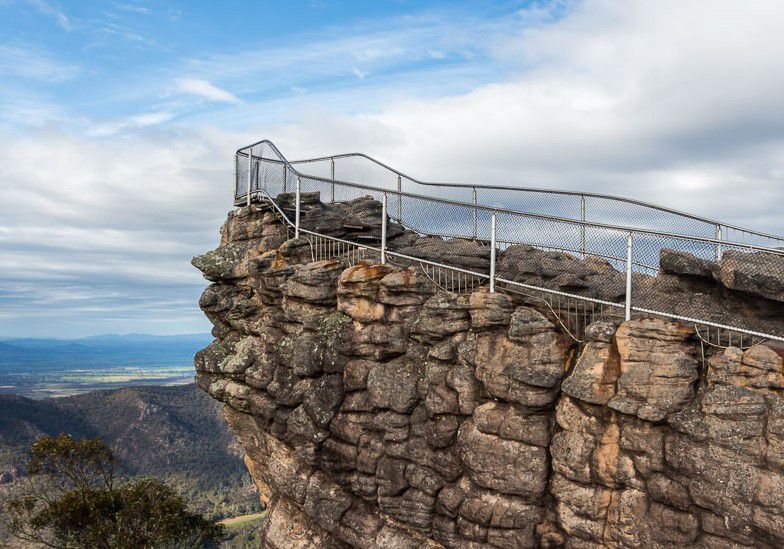
Declaration Crag, Plaque and Mitre Rock were three of the most accessible cliffs in Australia. You closed them. The other ones are a bit of a walk. We like walking and we don’t like signs, handrails, metal walkways and other “accessibility” upgrades. It’s fine just how it was.
Please don’t write to Parks Victoria and offer to help them “develop” Arapiles. The best thing about the area is its unchanging simple setup. We don’t want powered, individual camp sites, hot showers, interpretive steel walkways, handrails banged into the “bones of creation ancestors” or any of the dreams that developers want to make. Take one look at high impact sites in the Grampians for a reference to what we don’t want.
Engage engage engage $$$$
If they keep saying that word we are sure the economic miracle of nature based recreational users will eventuate.
41.07 when asked about how these climbing restrictions could impact on Natimuk and local businesses – their response was “PV is obliged to protect the natural and cultural values of this land but we see that as also providing opportunities – and the aim is to enhance the accessibility and the understanding of the landscape but supporting sustainable tourism and conservation. We believe through expanded nature based opportunities that will only help to feed into the local economy. There are opportunities to expand the outdoor recreational activities through the government’s investment. They have talked about plans to upgrade the trails, increase the visitor experience, the amenities be it toilets, tracks trails, carparks, camping. That will only expand to greater offerings for other user groups, and opportunities to really develop nature based tourism activities and hopefully in the future cultural tourism activities.”
BINGO!
What are these opportunities? They are closing half the park for starters – including several iconic summits (Pharos, Castle Crag, Mitre Rock, Dec Crag). Any new economic growth has to first offset the losses from the climbing bans and the subsequent demarketing of climbing which accounts for 90% of the users to the region. Even if they do find a new market for tourism growth is it really likely to match the current numbers of climbers? Unlikely.
Q&A climbers edition
The last 45 minutes of the presentation were devoted to questions and answers. However the questions were being chosen by the “facilitator” (it’s quite an ominous job title isn’t it?). We don’t really know how many questions they just ignored. We have been given a list of questions that Australian Climbing Association NSW sent to them in advance. Almost none were answered.
43m55 – Why have climbing organizations not been consulted? Dan “we would have liked climbers to have been consulted further in the preparations of the amendment but as we said its been about the values first and then whether we can provide the access”. “It’s not about how do we find the balance” So the decisions have been made by Parks Victoria, and they are just communicating this decision to the climbing community and climbing groups. It’s a one way street of information. No balance required.
47m34 – Will all 15 areas that are marked as “management required” be re-opened to climbing? “there is no guarantee that all 15 of these areas will reopen.” “There will be a way to reopen some of those areas. We need to do that work now to identity what that will look like” – we suggest you go climbing there today! Don’t wait for the inevitable disappointment of a permanent closure in the near future.
48m22 – What is the justification for closing entire climbing areas rather than individual climbs? “Why do we refer to areas rather than individual climbs? This was the assessment process – every area was looked at, all 153 areas. Is there a way of partially opening different climbs? Areas are a geographic unit that can be mapped so we refer to them as areas rather than individual routes that might exist… and for those 15 plus the one LTO area it was able to be found a way to make it accessible to certain means and for the other 64 that don’t have this also are available. The 73 other areas the values were extensive to a point where there wasn’t the ability to section off” Not a lot of evidence or clarity on that answer. Surely something as huge at the Pharos isn’t covered head to toe in “values”? And if it is – why are they allowing climbing to still occur there more than 2 years after the assessments were completed?
55m25 – Why don’t you talk about the climbing bans? “The concepts about bans and the like is something that we haven’t mentioned here but we have been so focused, the collective group, to understand the area, how people are using it, what is so special about the area and how we can find that wonderful co-existence between the values that have been there for thousands of years, the values that might be at risk, like threatened species, how we can provide the confidence to the community about how they can use the park, etc etc” – for a moment we thought there might have been a little empathy to the losses sustained by the climbing community – but no. Back to values again. We get it.
59m53 – Parks Victoria mentioned they will be policing these bans with staff on the ground. In 2020 we saw the NSW government spending over $7000 a week to employ guards to stop people climbing Mt Warning. Let’s hope that PV doesn’t go down that path. Their $1.7M funding boost would last 5 years.
Parks Victoria admits legislation unworkable and does not allow consultation
We wrote an article in 2020 that is worthy of a read – Parks Victoria Admits Heritage Regulations “Unsustainable”
This details how Parks Victoria themselves finds the current legislation around cultural heritage prohibitively expensive and a huge burden on resources at the expense of their usual work. They won’t admit this in public (don’t want to offend anyone who might be touchy and cancel them) – but the cold reality is this is draining them. They secretly wish for changes. These changes can only happen through political pressure.
The following Herald Sun article sums up the frustration felt by the current CEO of Parks Victoria this week when he fronted a government inquiry. Consultation is broken.
“The Parks Victoria boss has revealed what led to the controversial decision to close swathes of the Mt Arapiles national park and ban rock climbing. The head of Parks Victoria has defended the move to close certain areas of Mt Arapiles claiming the agency’s hands were tied because they do not have any say on cultural heritage. Matthew Jackson, CEO of Parks Victoria appeared before the Inquiry into the 2023-24 financial and performance outcomes, revealing the decision to close parts of the world-renowned park was not up for public consultation due to the state’s cultural heritage laws. “We don’t consult on cultural heritage,” he told the panel in a fiery exchange. “What we do is work with the First people’s State Relations who are the regulator … once the asset or the heritage has been notified, it’s registered and then we work through the process to make sure there is no harm into the future and to protect those parts of the heritage.” Defending the decision to close almost half of the sites surveyed, Mr Jackson said there were still plenty of places left open for people to enjoy and that rock climbers, who have been outraged by the decision can go to other locations such as Mount Buffalo in the state’s north east. When asked whether the economic impact on local communities near Mt Arapiles was taken into consideration Mr Jackson said that was not the agency’s job. “We are not here to model the economics, we are a land manager for the Cultural Heritage Act,” he said. Department of Energy, Environment and Climate Action secretary John Bradley, also appeared before the panel outlining that the Cultural Heritage Act was passed by the Victorian parliament, under the leadership of former premier Daniel Andrews, and that any decision to register sites of cultural significance sat with the team within the Department of Premier and Cabinet. The confirmation that Cultural Heritage laws were the driving factor behind the move comes after the State Government dropped the news to climbers on the eve of the Melbourne Cup and the US elections.“
So their hands are tied. We need to keep pushing our politicians to update the legislation that has us in this mess. The “system” has no umpire, no appeals process, no transparency & it facilitates secrecy. Under any other circumstance legislation like this would be labeled draconian, unacceptable & unworkable.
Visit our call to action page to find out how you can help.
 Save Grampians Climbing
kudos to the author, excellent writeup
LikeLike
damn disgrace the people who made these decisions should hang their heads in shame. NO public consultation just a whitewash of claims which 90% ? are not true??
LikeLike
Sadly, and it’s not news to anyone but our labor governments and the public service are working against the wishes of Australians and in direct contradiction of the last referendum.
Giving native title and controlling interest over more than half of the country and huge ocean areas will lead to trouble when every day Aussies get pushed too far… and that isn’t far away.
LikeLike
I’m curious about the claims of scar trees. How many trees would actually be old enough to have these indigenous scars? I imagine the older trees would be ones down in the flats – not impacted by climbing.
I remember the big protest over the Stawell highway expansion was over trees which arborists determined were only 80 years old – not old enough to be birthing trees or some other cultural heritage.
LikeLiked by 1 person