
The Draft Management Plan Addendum – July 2026
The long awaited update to the Disastrous Draft plan has been released.
Sorry we haven’t been able to do regular updates (catch-up time now), but in the last year or two, a newly invigorated Climbing Victoria has been steadily working behind the scenes.
Who is Climbing Victoria?
Climbing Victoria is the representative body for outdoor climbing in Victoria. They have board members appointed by the member climbing groups (like the VCC), and formed the Dyurrite Community Working Group (DWCG) specifically for the Arapiles/Djurrite issue. This included participants signing NDA’s around certain Cultural Heritage finds. Previously climbers have been completely locked out of any information / discussion around matters of Cultural Heritage, and this is a major step forward for positive relations in Victoria.
While greeted with some skepticism from sections of the climbing community (including us), there was a clear need for an organisation that was capable of dealing with PV, while being accepted to work with Traditional Owners (TO’s) on sensitive matters – around the intersections of climbing and Cultural Heritage. Whether that process would deliver outcomes acceptable to both sides was another question. Just trust us, they said.
But the proof is in the pudding, with the Draft Management Plan Addendum, where less than 5% of climbing routes are now requiring closure.
According to Climbing Victoria:
Approximately 70 climbs and 72 boulder problems to be closed which is around 4.4% of the 3,300 climbs and boulder problems at Arapiles. A further 47 climbs (1.4%) need rerouting or other mitigations such as descents changed.
Climbing Victoria has also secured a commitment for ongoing collaboration with the Barengi Gadjin Land Council (BGLC) and Parks Victoria to manage the park’s future, ensuring climbers remain active stewards of the site. This is a significant achievement, where previously even the word “Steward” was seen as offensive to some TO’s. We are thankful this hear the tone has shifted.
Of course not everyone is overjoyed, and the ACAV wasn’t exactly congratulatory, but were nevertheless happy to take some credit for being the organization that brought about “sustained pressure”.
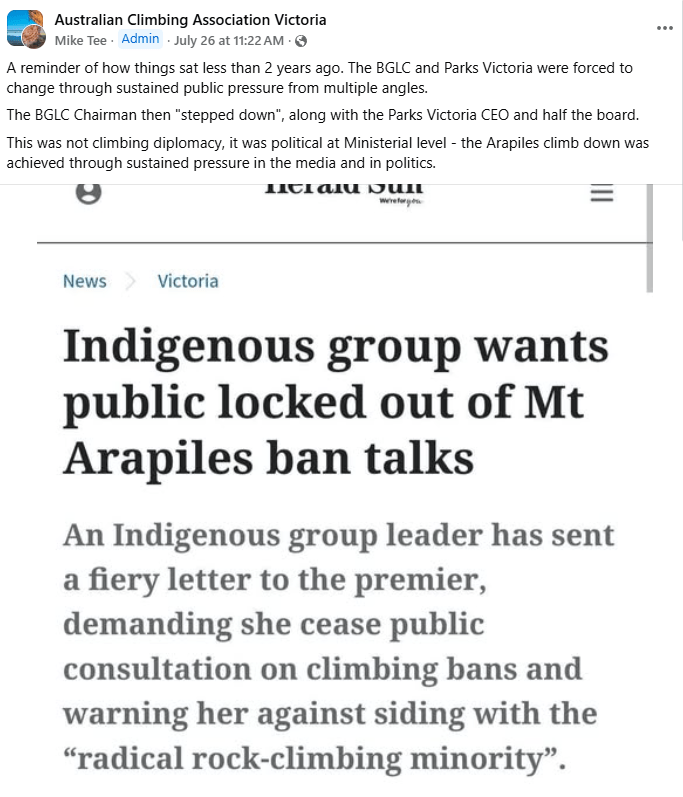
Here it is: Draft Management Plan Addendum – July 2026
Background Section.
In addition to recognizing the Wotjobaluk nations, history and cultural values, this plan also acknowledges feedback of climbers from the previous round of community consultation and notes (for the first time?) the significant personal connection climbers feel towards Arapiles. All those personal letters did make a difference.
“Through community consultation between November 2024 and February 2025, many participants emphasized the personal and communal value of the park. People shared personal stories about their experiences and love for climbing, as well as their care for nature at Dyurrite, including their stewardship of the landscape.” and…
“Climbing is a core recreational opportunity with the range and accessibility of climbs, from beginner grades through to some of the world’s most challenging climbs, makes Dyurrite a sought-after climbing experience, both locally and internationally.”
Section 3 – Evaluation Principles
The Addendum goes on to describe the evaluation process, where PV are shifting from ‘blanket bans’ to a “Guideance Framework” as a way to mitigate potential risks posed by climbing.
Indeed, it says “All assessment of risk under the Framework were demonstrable and evidence based”
Also –
All decisions regarding access, restrictions or prohibition remain the responsibility of Parks Victoria as the land manager in accordance with its statutory obligations, including under the Parks Victoria Act 2018, National Parks Act 1975 and regulations and Charter of Human Rights and Responsibilities Act 2006.
Evaluation Framework described:
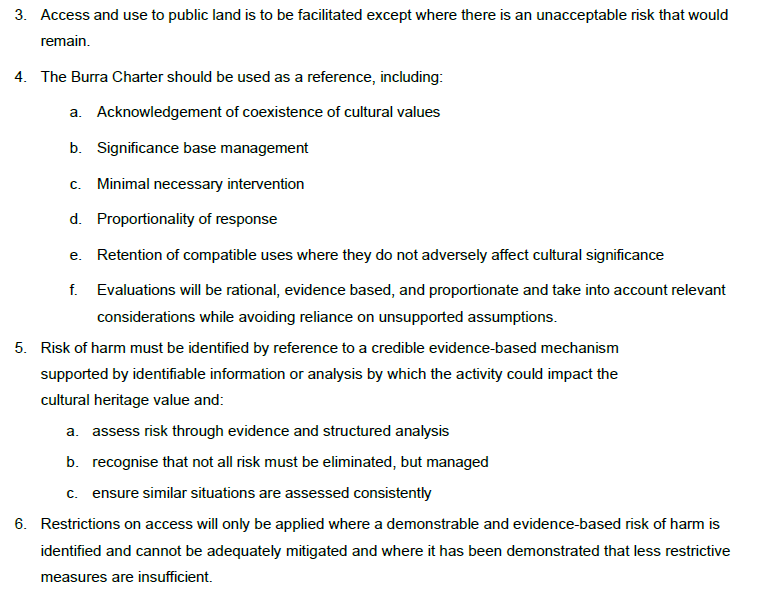
Section 4
Management strategies – these include working with BGLC to investigate what barriers or measures need to be put in place – the range of options is large, and it’s too early to say what steps will be taken. But it could include log barriers, fencing and ground hardening or platforms.
The tables in section 4 are of interest to climbers, as they list some detailed steps that would be undertaken in various areas to protect Cultural Heratige while still allowing climbing on the vast majority of routes. eg:
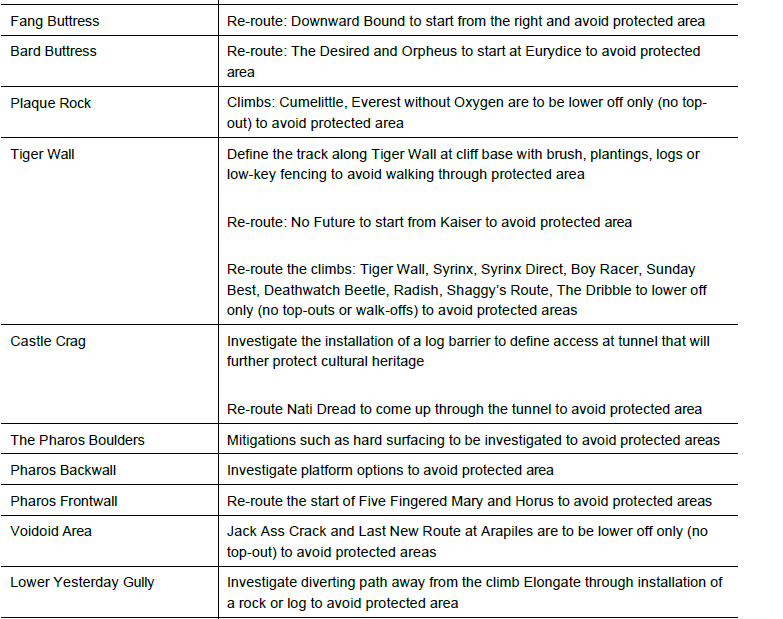
Section 5 – Appendices
Section 5.3
What’s closed?
We haven’t listed all the changes / closures – just the ones climbers will be most interested in.
Declaration Crag opens again for climbing. (no longer titled Taylor’s Rock – it’s the simple things!) Except Steps Ahead remains closed, and the East facing side where most of the CH exists. We don’t think too many climbers are upset with the loss of Braindeath boulder.
Colosseum Wall will lose the popular The Rack and Christian Crack
Pilot Error Wall loses a few routes, including Pilot Error, Togrul Khan, Tarzan
Plaque Rock and Fang Buttress opens again with some minor restrictions,
Tiger Wall (and numerous other areas) are to remain open with some mitigation that includes creating abseil stations and lower-offs in the affected areas.

Castle Crag also re-opens, with only a few climbs closed on the shady side.
Possibly the biggest loss is to a small section of the Pharos back wall – including the test pieces Masada and Trojan.
High Dive gully also sees a few losses: Incl Power Corruption and Lies & Cellular Destruction.
Mitre Rock sees a few easier routes re-routed, the only closure being Seamy Side (a very desperate 25 that has seen only a handful of ascents).
Section 6 Contains Definitions of Harm
We’re including / commenting on this only because we have highlighted the lack of defintions around these terms before. While we can still argue about whether climbing could harm Cultural Heritage (eg Quarrying), at least PV have provided definitions, rather than simply interpretations.

We’ll refrain from too much opinion, but to conclude, it appears most climbers (by “reading the room”) appear to support the Addendum, and are happy that Cultural Heritage can be protected without the wholesale banning of climbing.
This “fine grained approach” to climbing access, is, afterall, what many of us have been saying all along.
The Process
There is a great article on the overall process / summary in UK Climbing – an article written by Steve Monks, a long term Natimuk local climber.
Next Steps:
We encourage climbers to give feedback or support for the Addendum here: https://engage.vic.gov.au/dyurrite (Feedback is open until Aug19th)
Links to News articles:
The ABC was the first to break the news…
Wimmera News (Subscription required)
Gripped Magazine
Vertical Life:
Meanwhile, we should also note that it was as recently as April, where tensions where at their highest, with reports of ranger intimidation, which we haven’t forgotten:
At Tiger Wall, another climber described arriving to find no signage indicating restrictions before beginning their route. While their partner was on the wall, a person believed to be a ranger walked up, placed a metal “keep off” sign between belayers, and began photographing the climbers.
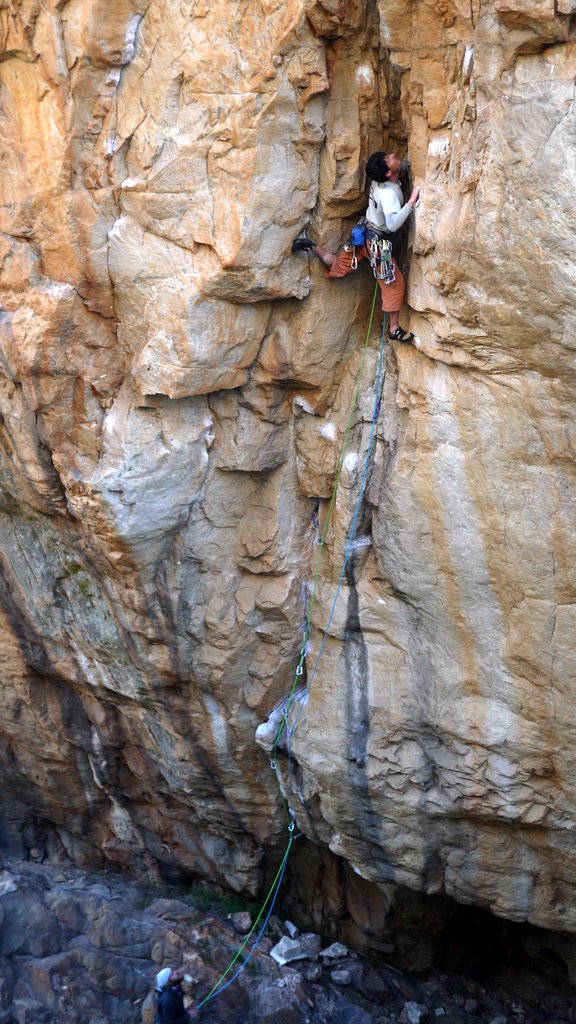
The Author, on Trojan 25 – one of the best climbs at Arapiles is one of the few climbs to be banned, and although we may never know exactly why (could be more Cultural Heritage than just quarrying), that we aren’t describing the loss of dozens of three star, world class climbs is by itself an answer to many prayers.
Next week: Stay tuned for an update on the Grampians – with a few recent re-openings, 50% is still banned… What will this Arapiles announcement mean for the Grampians
(hint, we don’t know, yet)


It’s a very good result. I didn’t think this would be the final result, great effort by all involved.
LikeLike